You are missing out!
Make sure you have javascript enabled and the most current version of the Flash plug-in

A Dedication to

Welcome dear friends, and one and all, to the Frank Sinatra dedication website. Here you'll find just a small taste of the Old Blue Eyes, a glimpse into his life and the legacy that he left behind.
About
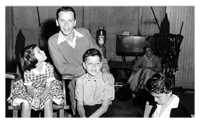
Frank Sinatra is one of the most popular singers in American history. As an actor, he appeared in fifty-eight films and won an Academy Award for his role in From Here to Eternity. His career started in the 1930s and continued into the 1990s.
Early years
Francis Albert Sinatra was born in Hoboken, New Jersey, on December 12, 1915, the only child of Italian immigrants Martin and Natalie "Dolly" Sinatra. His father was a fire-fighter for the city of Hoboken and his mother was an amateur singer who often sang at social events. Sinatra lived in a mainly Italian American working-class neighborhood. His first experience with music came when his uncle gave him a ukulele, and on hot summer nights he loved to go outside and sing while playing the instrument. His other interest was boxing. To protect himself in the tough neighborhood he grew up in, he became a competent boxer. In high school he was a generous but pugnacious (likely to fight) individual—the traits he would carry with him throughout his life.
Early in his life Sinatra knew he wanted to become a singer. His influences were Rudy Vallee (1901–1986) and Bing Crosby (1903–1977). He dropped out of high school and began to sing at small clubs. He got his first big break on the radio talent show Major Bowes and his Amateur Hour in 1935, singing in a group called the Hoboken Four. At this time Sinatra sang in various New Jersey nightclubs, hoping to attract the attention of "Swing Era" bandleaders. In 1939, he began working on radio station WNEW in New York City with bandleader Harry James for $75 per week. That same year he married his longtime sweetheart, Nancy Barbato. They would eventually have three children.
The beginning of success
After seven months with Harry James, Sinatra joined Tommy Dorsey and his orchestra, causing his career to skyrocket. Dorsey's orchestra was one of the most popular in the land, and it remained so with Sinatra singing with it from 1940 through 1942.
During that time, Sinatra performed with the band in his first two movies— Las Vegas Nights (1941) and Ship Ahoy (1942). He began his solo career at the end of 1942 and continued his meteoric (speedy and brilliant) rise.
Fans
The Swing Era lasted from 1935 through the end of World War II (1939–45; a war fought between the Axis Powers—Italy, Japan, and Germany—and the Allies—France, Great Britain, the Soviet Union, and the United States). Sinatra was by far the Swing Era's best-known vocalist. His musical roots combined Tin Pan Alley (the song writing center of New York City) and Italian opera. Most important to him throughout his career would be his insistence on his own style and arrangements for whatever music he sang, thus producing his own unique phrasing of lyrics and melody lines.
Though Sinatra was exempted from military service in World War II because of a damaged eardrum, he helped the war effort with his appearances in movies and benefits for soldiers. He was also an outspoken supporter of Franklin D. Roosevelt (1882–1945) and liberal viewpoints, including racial and religious tolerance. He made many appearances to support charities.
Sinatra's wide-shouldered suits and his bow ties were imitated by many men, but his most ardent followers were teenaged girls, nicknamed "bobby-soxers" for the ankle-high socks they wore. His widespread appeal was further fueled by America's explosive mass media growth in newspapers, magazines, films, record players, and radio stations. Sinatra was the first singer to attract the kind of near hysteria that would later accompany live appearances by Elvis Presley (1935– 1977) and the Beatles.
This type of excitement reached its peak in the Columbus Day riot of October 12, 1944. Thousands of his fans (mostly female) were denied entry into the already-packed Paramount Theater in New York City. They stormed the streets and vented their frustration by smashing nearby shop windows.
The 1950s
There were rumors that Sinatra was connected to the Mafia (organized crime). These stories arose mostly from his socializing with alleged Mafia kingpins (chiefs). He also received bad publicity about his noted bar-room brawls (fights) with customers and reporters. The allegations of underworld activity were never proven, and no criminal charges were ever made.
In 1954 Sinatra appeared in the critically acclaimed film From Here to Eternity (1954). The role won him an Academy Award for best supporting actor. He appeared in nine films in just two years, including Guys and Dolls (1955), Young At Heart (1955), The Tender Trap (1955), The Man With the Golden Arm (1955), and High Society (1956). Sinatra was back on the record charts as well with "Young at Heart." Nelson Riddle became his musical arranger in the 1950s, and he helped Sinatra stay on the record charts throughout the rest of the decade. (In fact, Sinatra stayed on the charts steadily through 1967, in spite of rock and roll.) Sinatra did not just record singles. He recorded albums around a central theme with a large collection of songs or ballads. From 1957 through 1966 he had twenty-seven Top Ten albums without producing one Top Ten single.
Sinatra's bobby-soxer fans were now adults and Sinatra had shifted smoothly to the role of the aging romantic bachelor. This was signified by the image of him leaning alone against a lamppost with a raincoat slung over one shoulder.
The 1960s
Sinatra's hits in the 1960s included "It Was a Very Good Year" and "Strangers in the Night" (1966). He reached the top of the singles charts in a duet, "Somethin' Stupid," with his daughter Nancy in 1967.
Sinatra continued to act in several movies in the 1960s, including Ocean's 11 (1960), The Manchurian Candidate (1962), Robin and the Seven Hoods (1964), and Tony Rome (1967). Many critics felt several of these films had declined in artistic merit. Sinatra became known as part of a group of friends called the "Rat Pack." It included entertainers Dean Martin (1917–1995), Sammy Davis Jr. (1925–1990), Joey Bishop, and Peter Lawford.
"My Way"
After Sinatra's famous recording of "My Way" (1969), he made an ill-fated attempt to sing some of the lighter tunes of modern rock composers. This led to a brief retirement from entertainment (1971 through 1973). At this time he also shifted his politics from liberal to conservative. He had become a close friend of Ronald Reagan (1911–), helping him in his later successful presidential campaigns.
Sinatra's financial empire produced millions of dollars in earnings from investments in films, records, gambling casinos, real estate, missile parts, and general aviation. He came out of his retirement in 1974 with a renewed interest in older tunes. His return to the limelight was highlighted by his famous recording of "New York, New York" (1980) as he entered his sixth decade of entertaining.
In 1988 Sinatra, Sammy Davis Jr., and Dean Martin embarked on a cross-country tour. The tour lasted only one week. Sinatra later organized another reunion tour with Shirley MacLaine (1934–) in 1992 and it was an undeniable success.
By 1994 Sinatra was experiencing memory lapses, but that did not keep him from performing publicly. He merely added the use of a prompter (device that shows the words of a song) to remind him of the lyrics. After celebrating his eightieth birthday at a public tribute, new packages of recordings were released and became instant best-sellers. But Sinatra's health continued to deteriorate in the 1990s. On the evening of May 14, 1998, Sinatra died of a heart attack in Los Angeles, California.
The audiences who grew up with him and his music were complemented by adoration from younger generations. They have all made "Old Blue Eyes" one of the most outstanding popular singers of the twentieth century.
Read more: Frank Sinatra Biography - life, children, history, school, mother, young, old, information, born, house, time http://www.notablebiographies.com/Sc-St/Sinatra-Frank.html#ixzz1JDpBAAMI
Discography
Discography
Columbia albums
1946 The Voice of Frank Sinatra
1947 Songs by Sinatra
1948 Christmas Songs by Sinatra
1949 Frankly Sentimental
1950 Dedicated to You
1950 Swing and Dance with Frank Sinatra
Capitol albums
1954 Songs for Young Lovers
1954 Swing Easy!
1955 In the Wee Small Hours
1956 Songs for Swingin' Lovers!
1957 Close to You and More
1957 A Swingin' Affair!
1957 Where Are You?
1957 A Jolly Christmas from Frank Sinatra
1958 Come Fly with Me
1958 Frank Sinatra Sings for Only the Lonely
1959 Come Dance with Me!
1959 No One Cares
1960 Nice 'n' Easy
1961 Sinatra's Swingin' Session!!!
1961 Come Swing with Me!
1962 Point of No Return
Reprise albums
1961 Ring-a-Ding-Ding!
1961 Swing Along With Me (retitled Sinatra Swings)
1961 I Remember Tommy
1962 Sinatra and Strings
1962 Sinatra and Swingin' Brass
1962 All Alone
1962 Sinatra Sings Great Songs from Great Britain
1962 Sinatra–Basie: An Historic Musical First (with Count Basie)
1963 The Concert Sinatra
1963 Sinatra's Sinatra
1963 Frank Sinatra and His Friends Want You To Have Yourself A Merry Little Christmas
1964 Sinatra Sings Days of Wine and Roses, Moon River, and Other Academy Award Winners
1964 America, I Hear You Singing (with Bing Crosby and Fred Waring)
1964 It Might as Well Be Swing (with Quincy Jones)
1964 12 Songs of Christmas (with Bing Crosby and Fred Waring)
1964 Softly, as I Leave You
1965 September of My Years
1965 My Kind of Broadway
1965 A Man and His Music
1966 Moonlight Sinatra
1966 Strangers in the Night
1966 That's Life
1967 Francis Albert Sinatra & Antonio Carlos Jobim
1967 The World We Knew
1968 Francis A. & Edward K. (with Duke Ellington)
1968 The Sinatra Family Wish You a Merry Christmas
1968 Cycles
1969 My Way
1969 A Man Alone
1970 Watertown
1971 Sinatra & Company (with Antonio Carlos Jobim)
1973 Ol' Blue Eyes Is Back
1974 Some Nice Things I've Missed
1980 Trilogy: Past Present Future
1981 She Shot Me Down
Qwest albums
1984 L.A. Is My Lady
Last Capitol albums
1993 Duets
1994 Duets II
Capitol albums
1956 This Is Sinatra!
1958 This Is Sinatra Volume 2
1959 Look to Your Heart
1961 All the Way
1962 Sinatra Sings of Love and Things
Reprise albums
1968 Frank Sinatra's Greatest Hits
1972 Frank Sinatra's Greatest Hits, Vol. 2
1966 Sinatra at the Sands (with Count Basie)
1974 The Main Event – Live
Post-career albums
1994 Sinatra & Sextet: Live in Paris
1995 Sinatra 80th: Live in Concert
1997 Frank Sinatra with the Red Norvo Quintet: Live in Australia, 1959
1999 Sinatra '57 in Concert
2005 Live from Las Vegas (Frank Sinatra album)
2006 Sinatra: Vegas
2009 Live at the Meadowlands
2009 Sinatra: New York
2011 Best of Vegas
Ratpack albums
1993 Frank Sinatra, Dean Martin, Sammy Davis Jr. at Villa Venice, Chicago - Live 1962
1999 Frank, Sammy & Dean: The Summit in Concert
2001 The Rat Pack Live at the Sands
2002 Ratpack: From Vegas to St. Louis
2002 Christmas with the Rat Pack
2003 The Ultimate Rat Pack Collection: Live & Swingin'
1946 Frank Sinatra Conducts the Music of Alec Wilder
1956 Frank Sinatra Conducts Tone Poems of Color
1957 The Man I Love
1958 Sleep Warm
1962 Frank Sinatra Conducts Music from Pictures and Plays
1982 Syms by Sinatra
1983 Whats New?